
Case study | Formaloo platform
See how a Wisconsin hospital cut repeat-patient intake time by 67% with a Formaloo-powered patient profile portal.

Industry
Healthcare
Company size
Mid-market
Products
Intake time
Staff time saved
Patient satisfaction
The challenge
The hospital kept accumulating patients' records, but they weren't connected to the forms patients and staff actually used day-to-day — booking an appointment, pre-visit intake, a referral, consent. It was either the patient re-entering the same details all over again — date of birth, insurance, medical history, allergies, etc. — or a staff member copying them over by hand from the patient's existing record into whatever new form was in front of them.
Multiplied across a busy intake desk, that repetition left steady odds of a transcription slip or a human error whenever the same details got copied over by hand, or filled out for the third time.
The solution
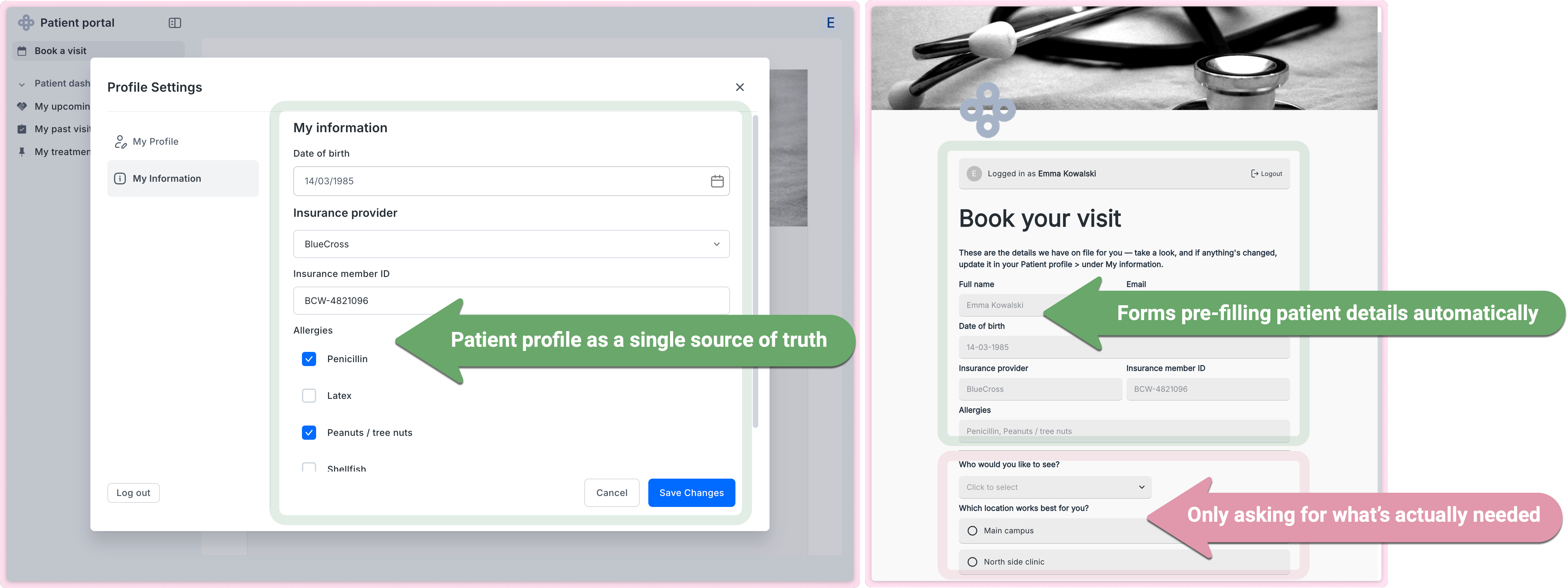
Using Formaloo Memory Forms, the hospital consolidated every patient's details into a single profile that any form — the ones they've already filled out and the ones still to come — can read from directly.
This started as standalone Memory Forms: a patient could sign up before filling in any form's specific details, building their profile once so it could be reused across other forms in the future.
This later evolved into a dedicated patient portal — a consolidated, secure space where patients can log in and manager their profile details, interact with whichever portal area they need to book a visit or fill out any other connected form, and look back on their past submissions — treatment notes, past requests, anything already on file — all in one place.
Sign-up can be as open or as controlled as the hospital wants: self-serve but gated behind a manual approval step before portal access, or closed off entirely, with the hospital importing and pre-approving patients so login only works for patients who are manually verified.
Visibility stays just as controllable: patients see only their own data — never another patient's details, and never the internal staff notes attached to their own submissions. Staff access is scoped by department: front-desk for scheduling and intake, clinical staff for visit and treatment notes, and anything administrative for management and admins only.
The impact
Patients no longer retype the same details at every visit — their profile carries over to whichever form they need next. Staff get the other half of that: a single source of truth, with every submission linked to the same profile and always up to date, so nothing needs double-checking or cross-updating across old forms.
Rolling the same profile and auto-fill out to more of its situational forms — prescription refill requests, lab result requests, appointment rescheduling — so returning patients stop retyping anywhere they interact with the hospital, not just at intake. Alongside that, the plan is to keep growing what the portal itself offers, adding new departments, capabilities, and patient areas over time.


