
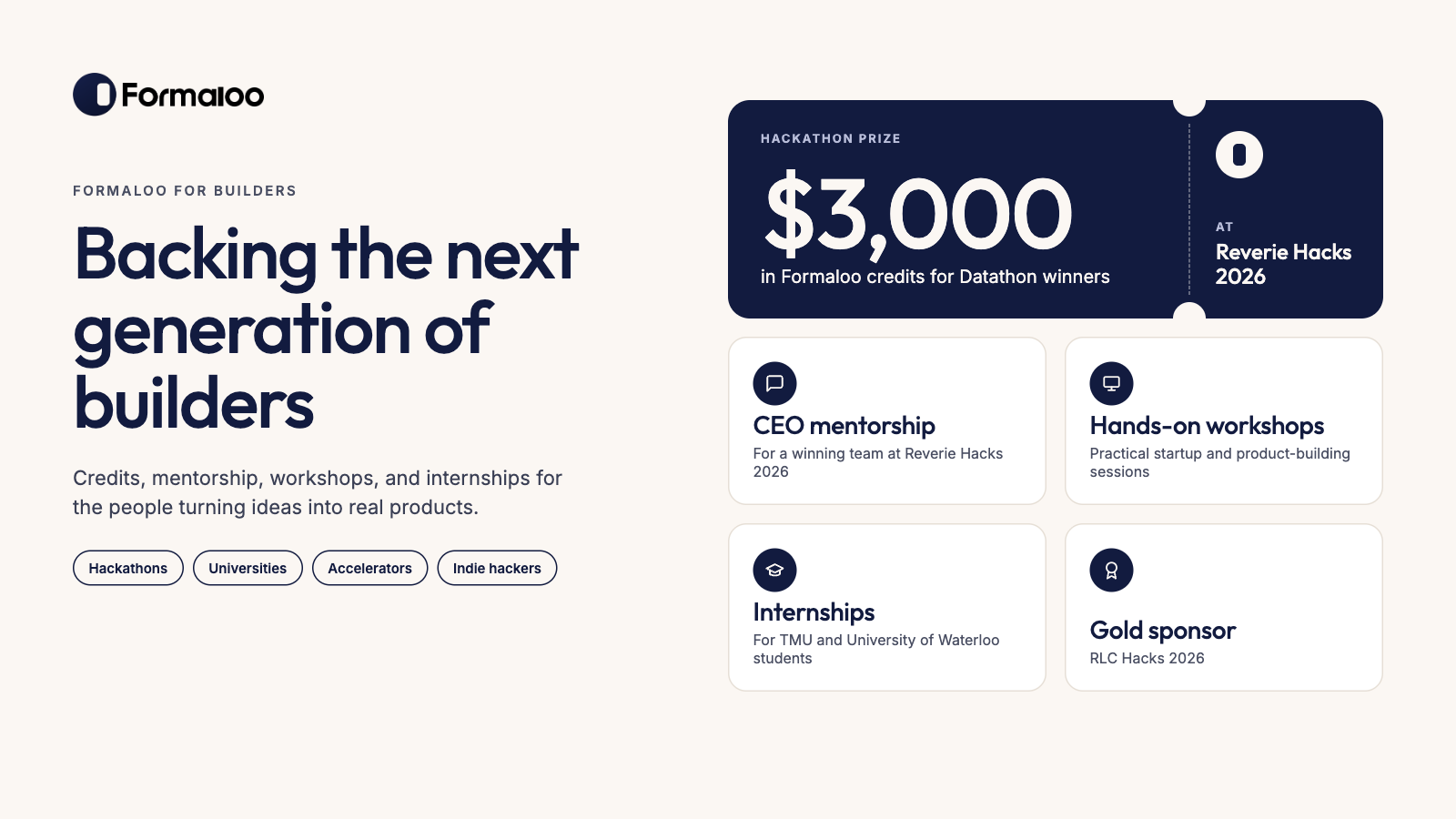
Backing the next generation of builders
From sponsoring hackathons and mentoring aspiring entrepreneurs to collaborating with universities and startup accelerators, Formaloo is investing in the people who will build the next generation of technology companies.
Every successful startup begins somewhere. Sometimes it's a university project, a weekend hackathon, an idea shared between friends, or a developer building something in their spare time.
What turns those early ideas into real businesses isn't just access to technology. It's having the opportunity to experiment, learn from experienced founders, find the right community, and receive support when it matters most.
At Formaloo, we believe the next generation of entrepreneurs deserves those opportunities, regardless of their background, location, experience, or access to funding.
That's why supporting startup and developer communities has become an important part of who we are.
Across Canada, the United Kingdom, Europe, the United States, and international developer communities, Formaloo works with hackathon organizers, universities, startup accelerators, bootcamps, and grassroots entrepreneurial initiatives. We contribute through software credits, sponsorships, practical workshops, mentorship, internship opportunities, and connections to the wider startup world.
Our goal: help more people go from having an idea to building something real.
Supporting hackathons where the next generation of founders gets started
Hackathons are among the most accessible entry points into entrepreneurship. They bring together developers, designers, students, aspiring founders, and curious problem-solvers, challenging them to turn an idea into a working product within a limited time.
For many participants, a hackathon is their first experience developing an MVP, collaborating on a product, presenting to judges, or receiving feedback from potential users. We want to help make those experiences possible.
Throughout 2026, Formaloo has supported a growing number of student-led and community-organized hackathons, including events hosted on Devpost, one of the world's best-known platforms for hackathon communities.
Our involvement includes:
- RLC Hacks 2026: Formaloo joined as a Gold Sponsor, supporting student developers building practical software and technology projects.
- Reverie Hacks 2026: We contributed $3,000 in Formaloo credits for Datathon winners, alongside an opportunity for a winning team to receive mentorship directly from Formaloo's CEO.
- HackSocial 2026: Formaloo provided $2,500 in platform credits across five winning projects, helping teams continue working on ideas with social and community impact.
- Neighborhood Hacks 2026: We supported a global hackathon for high school students, providing Formaloo workspace credits for the top three teams.
- GenHacks: We contributed Formaloo credits to the first-, second-, and third-place prize packages, supporting developers experimenting with emerging technologies.
- Cosmo Hacks 2026: Our planned involvement includes platform credits for winning teams and a workshop led by Formaloo's CEO, giving student builders access to practical startup and product-building experience.
These events bring together participants with different skills, ambitions, and levels of experience. Some are building their first applications. Others are experimenting with AI agents, automation, community tools, or technology-driven businesses. We believe both deserve support.
For us, sponsorship isn't about putting the Formaloo logo on an event page. It's about giving participants resources they can actually use, opportunities to learn from experienced entrepreneurs, and encouragement to keep developing their projects after the competition ends.
A great hackathon shouldn't be the end of a promising idea. Ideally, it's the beginning.
Beyond sponsorship: supporting founders through Divan
One of the initiatives especially close to our team is Divan, a global community connecting entrepreneurs, startup founders, mentors, and aspiring builders, with a particular focus on the Iranian entrepreneurial diaspora.
Formaloo has supported Divan as a sponsor, and members of our leadership have been actively involved in its entrepreneurial community and mentoring initiatives.
Divan represents something we strongly believe in: talented founders exist everywhere, but opportunities, connections, and access to experienced mentors are not distributed equally.
The first Divan Hackathon in 2025 showed what can happen when a community comes together to change that. The program received 355 applications from around the world, selected 50 teams from 11 countries, and brought together 27 mentors, with 14 teams reaching the final stage.
Unlike a traditional short hackathon, Divan's approach encourages participants to spend time validating their ideas, building prototypes, developing products, understanding customers, and learning how to bring something to market.
By supporting communities such as Divan, we hope to help aspiring founders overcome the barriers that can make entrepreneurship feel out of reach. We contribute experience, connect people with expertise, and help promising ideas find their next opportunity.
It's also a reminder that the value of a startup community is not measured only by how many companies raise funding. It's measured by how many people gain the confidence, practical knowledge, and connections to try building something of their own.
Working with universities to develop the next generation of talent
Hackathons and startup programs are only part of the picture. We also believe technology companies have a responsibility to create meaningful learning opportunities for students and young professionals.
At our Canadian operations in Toronto, Formaloo regularly welcomes interns from Toronto Metropolitan University (TMU) and the University of Waterloo, giving students hands-on experience inside a growing international technology company.
For students, working in a startup offers a very different learning experience from a traditional classroom. They see how a real product is developed, how technical and commercial decisions are made, how teams collaborate, and how a technology business responds to customers.
Understanding how to write code is important. But understanding which problems deserve to be solved, how to work with others, how to listen to users, and how to turn technical knowledge into something useful can be just as important.
Internships help bridge that gap. Students shouldn't have to wait until graduation to take part in the technology industry. Whether they become software engineers, product managers, researchers, or entrepreneurs, practical experience helps them build the confidence and skills to shape their careers.
Formaloo also works with educational institutions through its platform, helping schools, colleges, and universities build digital workflows, student services, applications, and other tools.
Education is more than one of the industries we serve. It's a community we believe is worth investing in.
Working with startup accelerators and incubators around the world
A startup accelerator can change the trajectory of an early-stage company. Beyond structured programs and practical workshops, the most valuable support often comes from access to experienced people, a community of peers, and the confidence to keep building through uncertainty.
Formaloo works with a wide range of accelerators, incubators, and startup support organizations across Canada, the United Kingdom, Europe, and the United States. Our involvement is particularly active in Canada, where we collaborate with organizations across the startup community to help emerging founders and young technology companies.
These relationships are about more than introductions or visibility. We want to make useful technology and practical startup knowledge more accessible to founders, whether they are validating their first idea, creating an MVP, onboarding their first users, or developing the processes needed to grow.
Early-stage teams often face the same challenge: there is more to build than there are people or hours available. Applications, lead tracking, customer feedback, onboarding, and internal coordination all take time. Formaloo helps founders put those essential workflows in place without building every system from scratch.
By collaborating with accelerator and incubator communities, we aim to give founders more room to focus on what matters most: discovering real customer problems, learning quickly, and turning good ideas into sustainable businesses.
From university classrooms to startup communities across Canada, the UK, Europe, and the US
While Formaloo supports builders internationally, Canada is a particular focus of our community involvement, alongside the United Kingdom, Europe, and the United States.
In Canada, Toronto is a centre of our operations and our startup community activity. We work with accelerator and founder communities, welcome university interns, and support people who are beginning their careers in technology and entrepreneurship.
In the United Kingdom, as Formaloo expands its presence, we continue building relationships with startup programs and entrepreneurial communities. We want to contribute to a culture where students, solo founders, and growing teams can exchange knowledge, test ideas, and access the tools they need to make progress.
Across Europe, our Estonian origins connect us to a region with a strong tradition of entrepreneurial experimentation. We work with the broader startup and accelerator community and see enormous potential in the next generation of European builders.
In the United States, we also engage with startup and builder communities, including online programs and hackathons that connect early-stage teams with practical resources and mentorship.
At the same time, many of the hackathons we support are open to participants anywhere in the world. A student joining remotely should have the chance to build and learn alongside people from established technology hubs.
Innovation shouldn't be limited by geography.
Helping indie hackers and solo founders build without unnecessary barriers
Not every promising company starts inside an accelerator or university. Some of the most creative builders are independent developers, solo founders, freelancers, and people experimenting with side projects outside their regular jobs.
These indie hackers often work with limited budgets, small teams, and little time to spare. They need tools that help them test ideas, reach users, collect feedback, and make progress quickly.
This connects closely to Formaloo's original mission: making software development accessible to more people.
What began as a platform for building forms and data-driven applications has grown into Formaloo OI (Operations Intelligence), bringing forms, portals, databases, workflows, AI agents, and operational automation together.
For independent builders, that means creating essential business infrastructure without spending weeks developing every internal tool themselves.
A founder can launch a waitlist, create an onboarding process, collect feedback, build a customer portal, manage workflows, or experiment with AI-powered processes while staying focused on the product they're bringing to market.
And because Formaloo offers a free starting point, people can experiment without an enterprise budget.
We want aspiring founders to spend more time testing ideas and less time dealing with operational complexity. The best tools should expand what someone can build, not become another barrier.
Giving back is part of how we build Formaloo
There is a principle in Formaloo's company culture that captures our approach to the startup community:
We want to contribute more to the communities around us than we take from them.
This belief shapes how we think about mentorship, education, collaboration, and the responsibility that comes with building a growing technology company.
We've benefited from experienced founders who shared their knowledge, startup programs that opened doors, and communities that helped us grow. Supporting the next generation is one way to give that support back.
It also keeps us connected to people experimenting with the future of technology. Students and independent builders often explore new ideas long before they become mainstream products.
We don't believe every hackathon project needs to become a high-growth company. Some will become startups, others open-source projects, and some will simply help participants develop skills that change their careers.
All of those outcomes matter.
What's next: more opportunities for builders
As Formaloo continues growing, we want our involvement in the builder community to grow with it.
We'll keep looking for opportunities to support hackathons, collaborate with universities, contribute to startup accelerators and bootcamps, and share practical knowledge with emerging founders.
Our focus will remain on making it easier for talented people to learn, experiment, and turn ideas into useful products, especially across Canada, the United Kingdom, Europe, and the United States.
Whether someone is joining their first hackathon, developing a startup during university, launching an independent project, or building a company through an accelerator, we want Formaloo to be part of a community that helps them succeed.
Because the next generation of great companies won't emerge from a single city, university, or accelerator. They'll come from people everywhere who have the curiosity to question how things work and the determination to build something better.
Our job is to help give more of those people a chance.
Building something? We'd love to support you
If you're organizing a hackathon, running a startup accelerator or bootcamp, developing an entrepreneurship program at a university, or building a community for independent developers and founders, we'd love to explore ways to collaborate.
We're always interested in initiatives that help more people become builders. Our support can include:
- Platform credits and technology resources
- Practical workshops
- Mentorship
- Sponsorships and community partnerships
To help us find the right way to support you, tell us:
- Your event or program name, dates, and format (online or in person)
- Who takes part, and roughly how many people
- What kind of support you're looking for
Tell us about your event or start building with Formaloo
Let's help the next generation of founders build something extraordinary.