We're no longer a form builder: Introducing Formaloo OI
We started by helping businesses collect information. Today we're announcing Formaloo OI, the intelligence layer that runs their entire operation, and a company restructure into four businesses.

We started by helping businesses collect information. Today we're announcing Formaloo OI, the intelligence layer that runs their entire operation, and a company restructure into four businesses.
Five years ago, Formaloo began with a simple idea: every business is unique, so every business should be able to build software around the way it actually works.
That idea took us further than we could have imagined.
Today, more than 40,000 businesses run on Formaloo every month. Millions of people interact with experiences built on our platform. We've helped companies replace endless spreadsheets, automate approvals, organize complex workflows, and turn scattered information into decisions.
We're incredibly proud of what our team and our community have built.
But everything up to this point was only chapter one.
Today, we're starting the next one.
The news
Formaloo is now Formaloo OI: Operations Intelligence.
Business Intelligence tells you what happened. Operations Intelligence makes the right thing happen. It understands how your organization runs, and then it runs it: it designs your processes, executes them, measures them, and improves them while they run.
It's a new category, and we're coining it deliberately. Dashboards and BI tools have spent two decades getting very good at describing a business back to itself. None of them do the work. Operations Intelligence is the layer that does.
This is not a product update. Alongside the platform itself, we're restructuring the company into four businesses and changing how we build. All of it lands over the coming months, beginning with the first OI product this summer.
Nothing our existing customers rely on goes away. Everything gets built on top of.
"We see the same pattern in nearly every organization we work with," said Farokh Shahabi, CEO and co-founder of Formaloo. "Teams inside large enterprises and growing businesses want AI running across their processes and workflows, and most of them get as far as a pilot or a demo and stop. That's why we now start with customers at the planning and design stage rather than at implementation. After designing and running tens of thousands of workflows and operations for Fortune 500 companies and fast-growing businesses, we've learned that the process design is the product. Formaloo OI is that lesson turned into a platform."
Why now
Right now, at a company you've definitely heard of, someone is opening a spreadsheet to check whether someone else replied to an email about an approval that was supposed to happen on Tuesday.
That person is excellent at their job. This is not their job.
Multiply that by every team, every process, every week, in every company on earth, and you get the biggest pile of wasted human effort in the modern economy. Not a small tax on business. The tax.
AI was supposed to end this. Instead, most companies are stuck one step short of it.
The hard part was never the model. The hard part is the process underneath it: who approves what, what happens on a rejection, where the data goes, and what the exception looks like at 5pm on a Friday. That knowledge lives in people's heads and in the habits of a team, not in any system. So when a company finally points AI at its own operations, there is frequently nothing there for the AI to run.
In the age of AI, badly designed operations stopped being an annoyance. They became the thing standing between a company and every advantage AI was supposed to hand it.
The part nobody puts in a press release
For most of our history, Formaloo was a very powerful DIY platform. Easy for simple things. Genuinely hard for complex ones.
That was our edge and our ceiling at the same time. You had to learn Formaloo deeply to get the best out of it. Smaller teams hit a wall on complex builds. Enterprises loved the power, dedicated real teams to us, and still ran into two problems that no software on its own can fix.
The first is that they can't adopt AI alone. There isn't enough in-house expertise, and there is completely reasonable hesitation about compliance, security, and data governance, particularly in regulated industries where a bad automation is worse than no automation.
The second is that they aren't workflow designers. They know their business better than anyone on earth. Turning that knowledge into a well-designed, optimized process is a different skill entirely, and it has always required outside experts.
So for the customers who needed us most, Formaloo was two things at once: hard to build, and hard to imagine. We heard it for years. This announcement is our answer to both.
What changed our minds
In late 2025 we tried something. Instead of handing enterprise customers a platform and wishing them luck, we got involved. Our people sat with them, redesigned their processes with them, and showed them what AI could actually do inside their operations, including for the teams who had no idea where to start.
We doubled the business. 100% growth, year over year.
The software didn't get twice as good in twelve months. We changed what we sell. We stopped selling a platform and started delivering outcomes.
It turns out we aren't the only ones who noticed. Microsoft, OpenAI, Anthropic, AWS, and Google are collectively pouring billions into embedded deployment teams: engineers who sit inside the enterprise and implement AI in real workflows. All five landed on the same conclusion at roughly the same time, which is that enterprise AI will not be adopted the way traditional SaaS was adopted.
"For twenty years the promise of enterprise software was 'here is the platform, good luck,'" said Shahabi. "We ran that model for five years and hit its ceiling ourselves. The next generation doesn't hand you a tool and walk away. It asks what outcome you're trying to reach, and then delivers it. That's software plus service, and the whole industry is moving there at once."
The giants are building this for models and infrastructure. Nobody owns it yet for the layer where businesses actually live, which is their operations. That's the one we're taking.
What Formaloo OI actually does
Formaloo OI runs on three movements: Collect, Understand, and Act. Most software stops after the first. Some gets partway through the second. The third is where the category is won.
Collect: the next generation of forms is not more forms
For thirty years, the deal between a business and the people it serves was simple, and bad: if you want the information, make somebody fill in a form. That deal was broken on both sides. The people filling forms resented the work, abandoned them halfway, and gave shallow answers when they did finish. The teams on the other end resented building those forms, chasing the responses, and cleaning up whatever came back.
Formaloo OI ends that arrangement. Information gets gathered through whatever channel the person is already using, whether that's a chat, a voice conversation, a message thread, or a link, and the system fills in everything it already knows instead of asking twice. Returning customers don't restate their history. Agents ask the intelligent follow-up question that a static form could never ask, and stop asking when they have what they need.
For the business, that shows up as measurably higher completion rates, cleaner structured data arriving without manual repair, and nobody on the team assigned to chase anybody.
Understand: the next generation of dashboards is not more dashboards
Collected data is only useful if somebody can get an answer out of it, and for most teams that has meant commissioning a dashboard and waiting.
With Formaloo OI you ask the question in plain language and get the answer back with the chart already attached. You don't read a dashboard. You get an answer. The system knows the shape of your operation, so it can explain not just what the numbers say but where in the process they came from, which stage is leaking, and which step is quietly costing the most time.
When the question is bigger than a company's own data, our Formaloo Research team designs and runs the study itself, including large-scale market and product research programs that reach millions of respondents. Research becomes something an enterprise can commission alongside the platform rather than a separate procurement exercise.
Act: everything that can be automated, will be
This is where old software stopped, and where Formaloo OI starts.
Once a process is understood, Formaloo OI runs it. It sends the follow-ups, the reminders, the emails, and the text messages. It generates the PDFs, collects the eSignatures, routes the approvals, and works the checklists. It drives ATS pipelines, live dashboards, funnels, and lead scoring. Every step is connected to every other step, so the process behaves like one system rather than a pile of disconnected automations, and it improves itself as it runs by watching where things stall and adjusting.
Nobody builds a task. Nobody sends a reminder. Nobody copy-pastes anything into the CRM. The work just… happens.
The company behind it is changing too
Formaloo becomes a holding company: one powerful platform at the heart, and forward-deployed teams around it that put that platform to work inside real enterprises. Four businesses, one strategy.
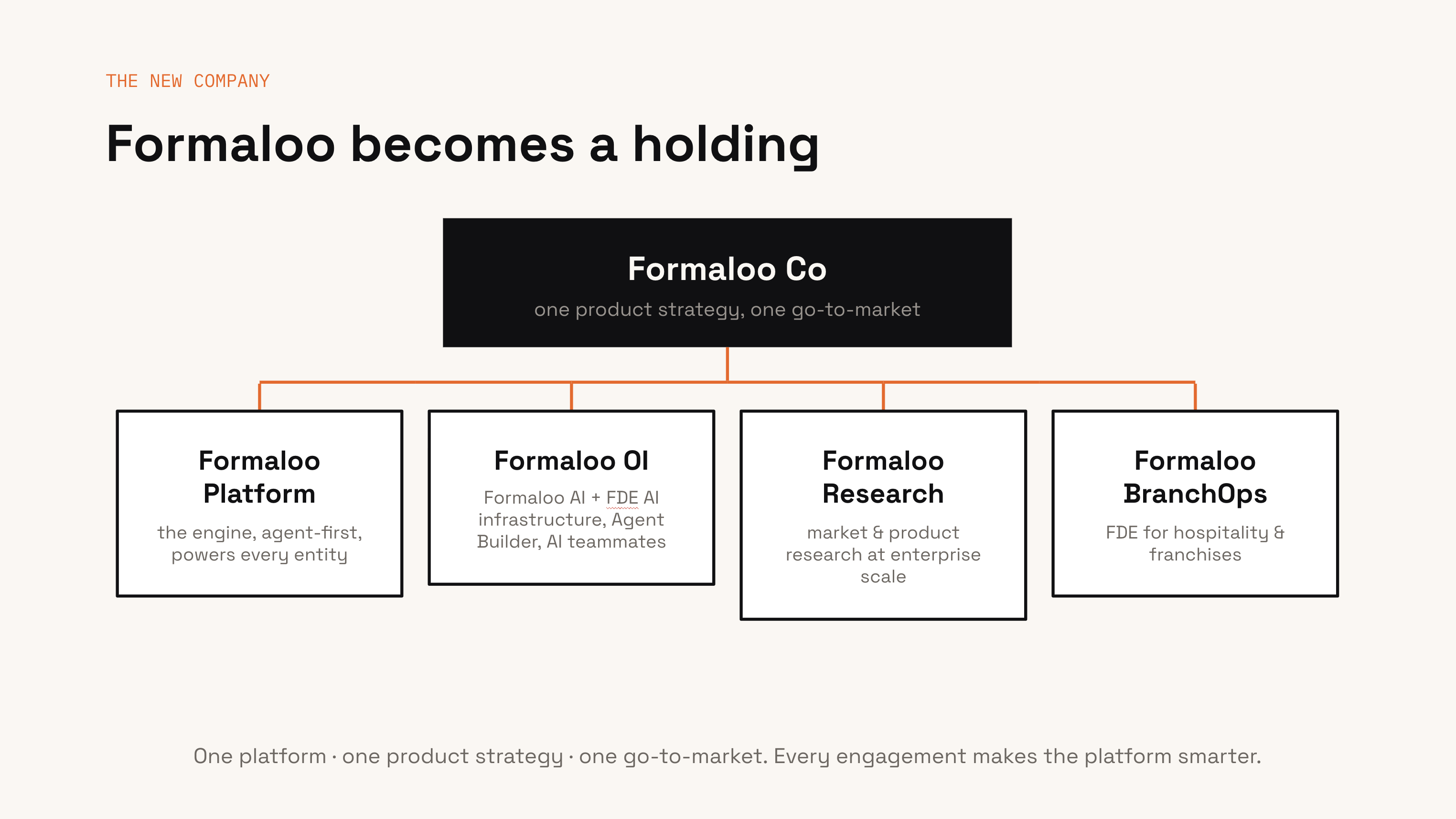
Formaloo Platform is the engine underneath all of it, rebuilt agent-first, with one mandate: stay powerful enough for the most complex enterprise process while becoming easy enough that nobody has to "learn Formaloo" ever again. Every other business in the group runs on what this team ships.
Formaloo OI is the North Star, and everything else in the group exists to serve it. It is the next generation of our platform, delivered the way enterprise software will be delivered from here on: software and a service, as one thing. The software half is the agentic platform, which designs, builds, runs, and optimizes an entire operation from a description. The service half is a forward-deployed team whose engineers and process designers sit inside the customer's business, redesign the operation alongside the people who run it, and take it live. Neither half delivers the outcome on its own, which is exactly the point. Customers stop buying a tool from us. They bring a problem, and we bring the outcome with the platform inside it.
Formaloo Research handles the questions that data alone can't answer, designing and running complex market and product research programs powered by Formaloo OI and rich datasets, at a scale that reaches millions of people.
Formaloo BranchOPs is a dedicated company for hospitality and multi-branch operations, where one business can mean hundreds of locations and thousands of daily processes, and where the cost of operational drift is measured in millions. It's already live with some of the largest names in the industry, and it's the template for the verticals we enter next: healthcare, education, and research.
Four teams, one platform, one product strategy, one go-to-market. Every engagement any of them runs makes the platform smarter for all of them.
What ships this summer
The first product to carry the OI name is our Agent Builder, and the fairest comparison is what Cursor did for writing software: you describe the outcome you want in plain language, and the system produces the working thing.
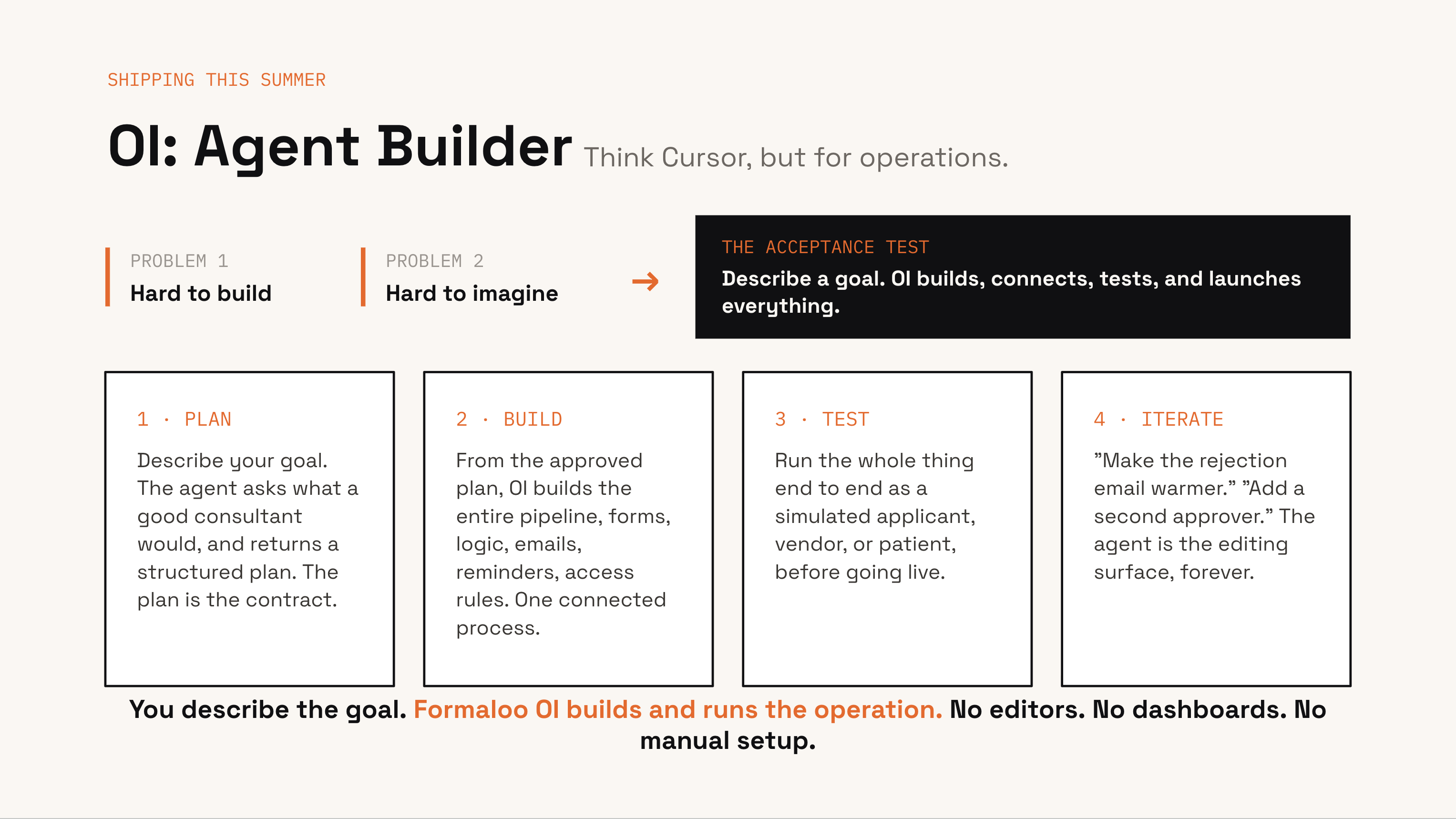
It begins with a conversation rather than a canvas. You describe a goal, something as loose as "improve our approval process" or "engage my customers," and the agent asks you the questions a good consultant would ask before touching anything: which channels, which approvers, what tone, what happens at the edges. What comes back is a structured plan of the entire process, and you approve it or change it before a single object exists. The plan is the contract.
Once you approve it, the agent builds the whole thing. Forms, conditional logic, emails, PDF templates, reminders, follow-ups, and access rules arrive as one connected process rather than a pile of loose objects that somebody then has to wire together.
Before any of it reaches a real person, you run it end to end yourself as a simulated applicant, vendor, or patient, and watch what actually happens at every step. If something's wrong, you go back to the plan and change it there.
After launch, the agent stays the editing surface. "Make the rejection email warmer." "Add a second approver." "Route anything above fifty thousand to finance." The process changes by conversation, permanently, which means the person who owns the operation is the person who can change it.
No editors. No dashboards. No manual setup. You describe the goal. Formaloo OI builds and runs the operation.
Every business runs on processes, and almost every business runs them badly. That was never a talent problem. Nobody taught business people to think in systems, and no tool ever carried that weight for them.
From today, one does.
Formaloo OI. Operations Intelligence.
We free teams from operational complexity, so they can do the work they actually want to do.
About Formaloo
Formaloo is an Operations Intelligence company. Its platform helps organizations collect the information they need, understand what it means, and then automatically run and optimize the processes that information feeds, from approvals and assessments to applicant tracking, intake, and onboarding. More than 40,000 businesses use Formaloo every month. The company operates four businesses: Formaloo Platform, Formaloo OI, Formaloo Research, and Formaloo BranchOPs.