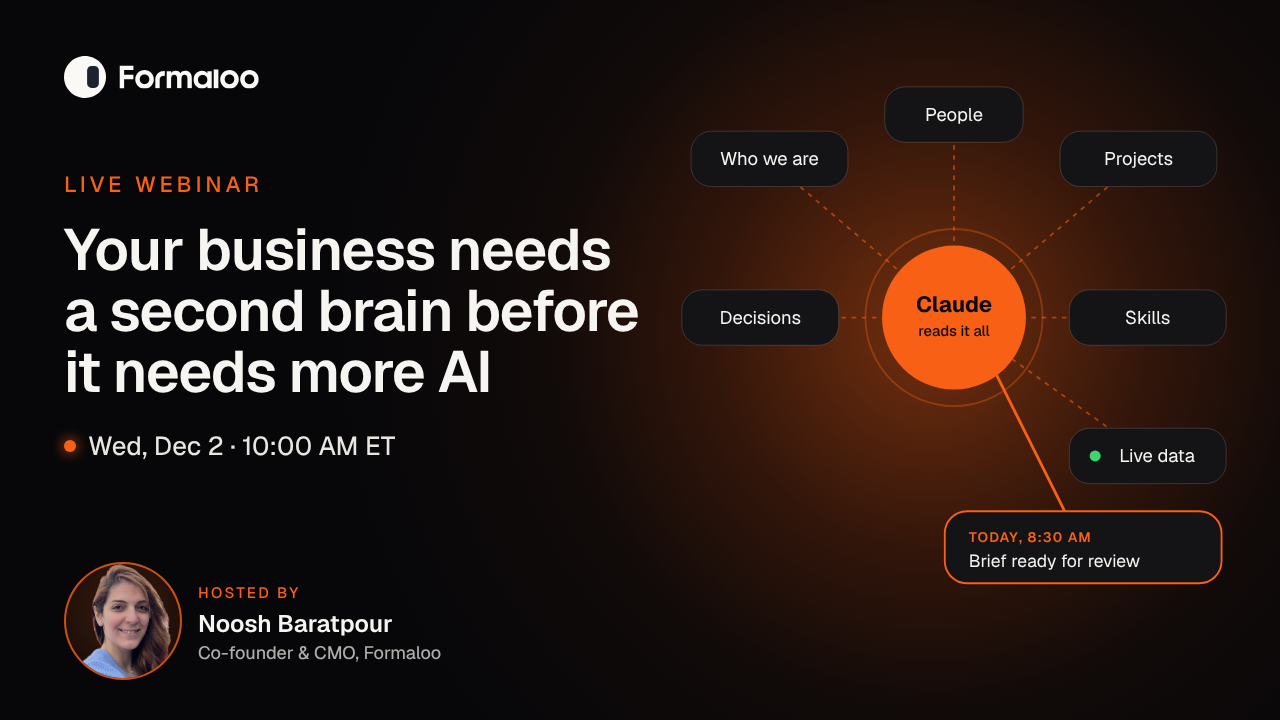
Your business needs an AI second brain before it needs more AI. An AI second brain is one shared place that holds how your business works: who you serve, how you decide, who owns what, and the steps behind every recurring task. Without it, every AI tool starts from zero, so its answers stay generic no matter how good the model gets.
In this live webinar, Noosh Baratpour, Co-founder and CMO of Formaloo, shows the business second brain she runs Formaloo's marketing on, built with Claude and Obsidian, and how you can build your own.
What is a business second brain?
A business second brain is a set of plain notes that your team and your AI read before they do any work. Most second brain guides cover a personal setup for one person's ideas. A business version holds the things a company usually keeps in a few people's heads: your positioning, your voice, your clients, your projects, the decisions you made and why, and the playbook for each recurring job.
Why does your AI stay generic without one?
Your AI stays generic because it doesn't know your business, so it guesses. You re-explain your clients, your tone and your rules in every chat, and the AI still misses the decision you made last month. Adding another AI tool doesn't fix that. Giving every tool the same memory does.
What goes into an AI second brain?
A useful AI second brain has a small, fixed structure that both people and AI can find their way around:
- Who we are: what the business does, for whom, and how it talks.
- A map: one page that says where everything lives.
- People and projects: who owns what, and where each piece of work stands.
- Decisions: what you decided, when and why, so nobody argues the same point twice.
- Skills: one note per recurring task, with the steps, the standard and the tools it uses.
How do Claude and Obsidian work together as a second brain?
Obsidian holds the notes as plain Markdown files that people can read and edit, and Claude reads them before it starts any task. Claude opens the "who we are" note and the map at the start of every session, follows the skill for the task at hand, and writes what it did and decided back into the notes. The memory grows with every task instead of disappearing when the chat closes.
How do you connect a second brain to live business data?
You connect Claude to the tools where your work already happens, so the second brain combines what you know with what just changed. In the demo, Claude pulls registrations and form responses from Formaloo through the Formaloo MCP, alongside the team's project tracker and calendar, and saves the results back into the vault.
What will you see live?
- The vault: the folders and notes of a working business second brain, and why each one exists.
- Claude reads it: a session where Claude already knows the business, the voice and the rules before the first prompt.
- Live data: Claude pulls what changed from connected tools, Formaloo included, and writes the result back.
- Work on a schedule: a recurring job runs on its own, Claude does the legwork, and a person reviews and decides. This webinar's own setup ran on that system.
Who should attend?
Ops leads, founders and process owners who use AI every day but still re-explain their business to it. It also fits team leads whose know-how sits with one or two people, and anyone who tried a second brain for themselves and wants one the whole business can use. No coding needed.
What will you leave with?
- Why AI tools stay generic until your business has a memory they can read
- The structure of a business second brain you can copy
- How to connect it to live data and let recurring work run on a schedule, with people still making the calls
FAQ
Is it recorded?
Yes. Register and we'll send you the replay.
Do I need to code?
No. The second brain is a folder of plain notes, and you work with Claude in plain language.
Is this a personal or a company second brain?
A company one. The session focuses on knowledge the whole business depends on, not one person's notes.
Do I need Formaloo?
No. The method works with any tools. Formaloo shows up in the demo as one of the connected data sources.
For a related live session, watch Your intake form should chase missing info, not people.
Live on Wednesday, December 2, 2026, 10:00 to 11:00 AM ET. Can't make it? Register and we'll send the replay.