.png)

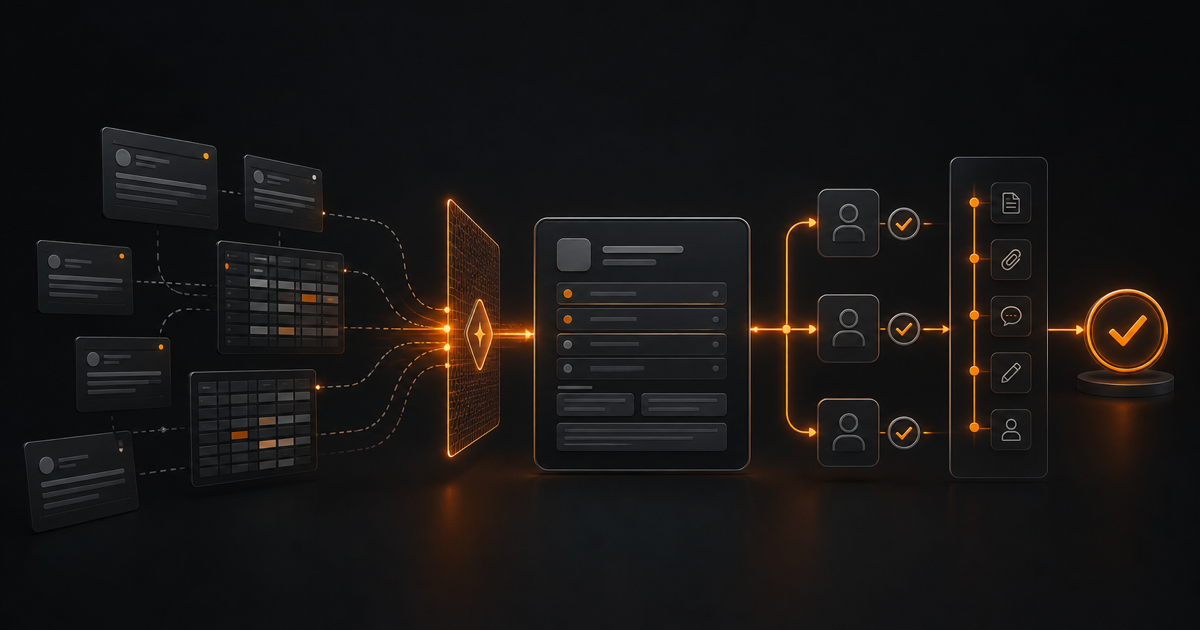
Turn a painful operational process into a running system through ten stages: diagnose, redesign, architect, build, test, deploy, adopt, measure, expand, and productize. Automation starts after the team understands the outcome, waste, authority, and exceptions.
A working system is more than a digital form. It gives every case a clear record, state, owner, decision path, evidence trail, exception route, and operating measure.
Source review: August 28, 2026. This playbook is directional; adapt it to your legal, security, compliance, architecture, and change-management requirements.
1. Diagnose the operating problem
Observe the work and sample actual cases. Measure complete-first-time rate, waiting time, active handling time, handoffs, returns, exceptions, duplicate entry, and failed follow-up. Interview requesters, operators, decision-makers, system owners, and support teams.
Describe the problem in outcome terms. “The vendor-onboarding spreadsheet is messy” is a symptom. “Requesters cannot see missing evidence, risk reviews start late, and operators manually reconcile three systems” is a diagnosable operating problem.
2. Redesign before automating
Challenge every field, review, handoff, and approval. Remove information nobody uses. Combine duplicate checks. Move evidence collection earlier. Separate risk review from financial authority. Define what can proceed in parallel.
The U.S. GAO Business Process Reengineering Assessment Guide emphasizes mission, performance problems, customer needs, and process constraints before solution selection. Use that discipline to avoid digitizing waste.
3. Architect the operating system
Translate the redesigned process into seven components:
- Record: The stable case ID and authoritative data.
- State: The current condition and allowed transitions.
- Ownership: The person or team responsible now.
- Rules: Validation, routing, authority, deadlines, and actions.
- Evidence: Inputs, decisions, reasons, timestamps, and changes.
- Interfaces: Forms, queues, portals, notifications, and documents.
- Connections: Source systems, downstream actions, and recovery behavior.
Keep business authority separate from configuration. A threshold belongs in an approved policy and in the workflow logic that implements it.
4. Build the smallest complete path
Choose one bounded case type, business unit, or geography. Build the path from valid intake to a real completion state, including one common exception and one failure path. Do not call a form prototype a pilot if no team can operate the full case.
For vendor onboarding, the first path might cover one supplier class, structured evidence, procurement review, risk review, final decision, supplier record handoff, and returned-request handling.
5. Test rules, permissions, and recovery
Test normal cases, boundaries, contradictory evidence, incomplete submissions, unavailable reviewers, changed facts, duplicate requests, integration failure, and role permissions. Ask someone who did not build the system to run the cases.
Define the expected result before the test. Record actual behavior, evidence, owner, and resolution. A successful happy-path demonstration does not prove operational readiness.
6. Deploy with a controlled boundary
Release to a named group with clear entry criteria, support ownership, monitoring, and a continuity path. Decide how existing work is treated. Communicate what changed, what remains out of scope, where to get help, and which old channel should no longer accept new requests.
Make the first operating window observable. Review failed actions, stale cases, overrides, returns, and support questions every day until the pattern stabilizes.
7. Build adoption into the work
Training should use real roles and cases. Give requesters a clear entry point, operators a prioritized queue, reviewers the evidence needed to decide, and managers measures they can act on.
Remove parallel habits deliberately. If email remains the easiest route, people will keep using it. Redirect old entry points, assign champions, publish escalation paths, and treat recurring workarounds as design evidence.
8. Measure the operating result
Compare the same definitions before and after launch. Useful measures include:
- complete-first-time rate;
- queue and active handling time by stage;
- return, exception, and override rates;
- overdue work and age of the oldest case;
- failed integrations and reconciliation time;
- adoption by eligible team or request type;
- quality or control outcomes tied to the original problem.
The approval workflow metrics guide explains why total cycle time alone can hide the real bottleneck.
9. Expand one variable at a time
Add a new business unit, case type, system connection, or rule set only after the current scope produces usable evidence. Each expansion changes training, permissions, exceptions, support, and measurement.
Reuse the architecture, not assumptions. A similar process may have different authority, data sensitivity, or failure consequences.
10. Productize the operating capability
Once the system is stable, define a reusable intake, design standard, component library, test catalog, documentation template, change process, support model, and governance review. This turns one project into a repeatable way to improve operations.
Productization also means continuing ownership. Name who funds, prioritizes, maintains, measures, and retires the capability.
How Formaloo supports the ten-stage path
Formaloo can combine structured forms, logic, approvals, operational Data Block views, portals, documents, integrations, and AI-assisted analysis in one operating system. Use webhooks for controlled connections where they fit, with explicit failure and reconciliation paths.
Formaloo OI connects collection, understanding, and action. Formaloo's current home and about pages also describe forward-deployed experts who work with business, operations, IT, and security teams to redesign and deploy critical operations. That approach fits organizations that need both a platform and hands-on delivery around a complex process.
Start with one painful process
Choose a process with a clear owner, material pain, enough evidence to measure, and a bounded first scope. Improve the work, build the complete path, and earn expansion through operating results.
If your team needs to turn a fragmented process into a connected operational system, book a Formaloo demo.