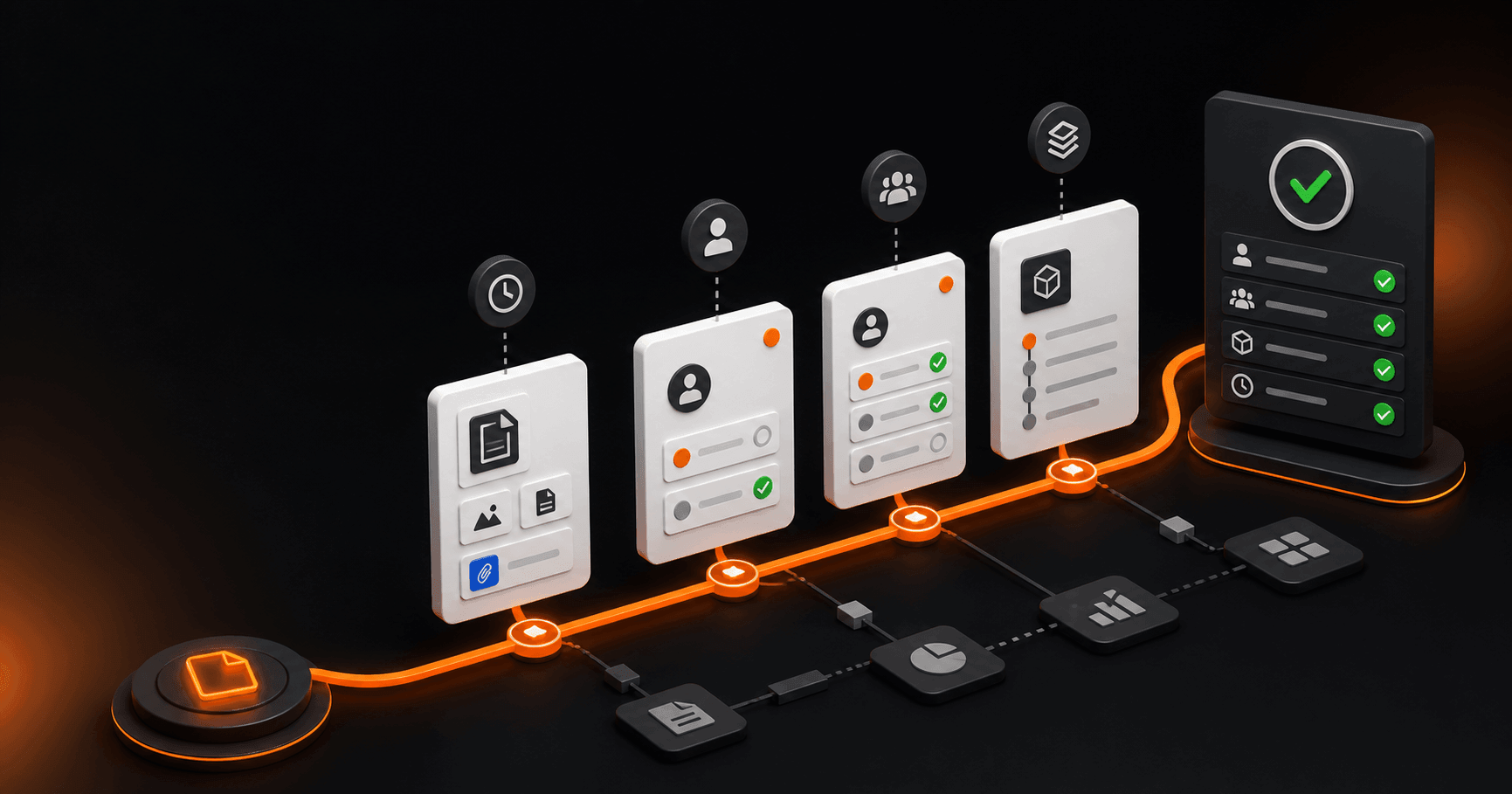
Workflow fallback and recovery: keep critical work moving
Build a controlled fallback, restoration, and reconciliation plan for critical workflows and failed dependencies.
.png)

A workflow fallback and recovery plan must define how to detect failure, stop unsafe automation, triage open work, continue only authorized urgent processing, restore service, and reconcile every temporary record. A backup spreadsheet without ownership, identifiers, and a return-to-service procedure is another uncontrolled workflow.
Design continuity around the business outcome, not only the application. A technically restored system is not recovered until cases, decisions, messages, and downstream records agree.
Source review: August 28, 2026. Adapt continuity and recovery controls to your organization’s security, legal, regulatory, records, and business-impact requirements.
Define what failure means
Failure is broader than a full outage. The workflow may be available while producing unsafe or incomplete results. Define detection signals for:
- users cannot submit, view, or update work;
- an integration is delayed, duplicated, or returning errors;
- notifications or documents are not generated;
- permissions expose or hide the wrong records;
- a rule routes cases to the wrong owner or action;
- queue counts, states, or downstream totals no longer reconcile;
- performance has degraded beyond the agreed operating threshold.
For each signal, name the monitoring source, alert threshold, responder, escalation time, and authority to declare degraded operation.
Classify the business impact
Not every workflow or case needs the same fallback. Classify impact using safety, legal or regulatory deadline, financial exposure, customer harm, data sensitivity, reversibility, and time to consequence.
Create three practical response levels:
- Pause: No case should move until the system is trusted again.
- Urgent continuity: Only defined high-consequence cases may proceed through the approved temporary path.
- Degraded service: Work may continue with reduced automation, extra review, or slower service targets.
The continuity owner, not each requester, decides which level applies.
Stop unsafe actions before starting a workaround
Containment prevents one failure from becoming many. Disable or isolate the affected action where possible, stop repeated retries that may create duplicates, preserve logs and error responses, freeze untrusted exports, and communicate the status to operators.
Do not instruct teams to submit the same case through several channels “just in case.” That makes later reconciliation unreliable. Give each case one temporary path and one stable identifier.
Build a controlled temporary intake
NIST contingency guidance recognizes alternate manual or technical processing, including manual forms, temporary workstations, and queued input. The temporary path should collect only the minimum information required to continue authorized work.
Include:
- a continuity case ID and the original case ID if one exists;
- requester, received time, impact class, and deadline;
- current state and last trusted action;
- required evidence and its controlled location;
- temporary owner, reviewer, and decision authority;
- every manual action, decision, message, and downstream update;
- reconciliation status and final production record ID.
Restrict access and exports. A continuity tool is still an operational system containing real business data.
Preserve authority during degraded operation
Availability pressure must not silently expand decision rights. Define which roles may approve, reject, defer, or override during continuity; which decisions need two-person review; which actions cannot be performed manually; and who may accept increased risk.
Use an explicit decision record. Capture the applicable policy version, evidence, reason, reviewer, timestamp, and any temporary exception. If the usual separation of duties cannot be maintained, pause the affected decision or use a pre-approved alternative.
Restore the service to a known state
Recovery is a controlled release. Confirm the cause or containment, validate configuration and permissions, test critical paths, check integrations, verify monitoring, and decide how open production cases will be treated.
Use a recovery checklist with an accountable approver. NIST guidance emphasizes detailed recovery procedures and restoration to a known state. Keep configuration, dependency, contact, and recovery instructions current enough that a qualified responder can follow them under pressure.
Reconcile before declaring recovery complete
Importing temporary records is only one step. Reconcile:
- Every continuity case to one production case.
- Every decision to the authority and evidence used.
- Every notification, document, payment, or downstream action.
- Every failed or retried integration by correlation or idempotency key.
- Every duplicate, missing record, and conflicting state.
- Every temporary file according to approved retention and disposal rules.
Record who reconciled the case, when, the differences found, and how they were resolved. Keep the incident open until the business records agree, not merely until the application loads.
Test the plan as an operating exercise
Run at least four scenarios: platform unavailable, critical integration unavailable, incorrect workflow rule, and delayed discovery after work has already moved. Include operators, decision owners, IT, security, support, and downstream teams.
Measure detection time, containment time, time to authorized continuity, backlog growth, reconciliation errors, duplicate actions, and time to normal operation. GOV.UK service guidance emphasizes monitoring real user outcomes and maintaining a sustainable response plan. Use the exercise to revise thresholds, contacts, permissions, and documentation.
How Formaloo fits the continuity design
Formaloo logic can route defined cases, trigger actions on submission or update, and make configured paths visible through the Logic map. Formaloo’s documented webhooks retry failed deliveries for supported form events.
Those capabilities can contribute to a resilient design, but they do not replace a business continuity plan. Define receiving-system duplicate controls, alerting, manual authority, temporary intake, restoration, and reconciliation around the full operation.
Design the recovery path before the incident
If you need to turn a critical process into a governed workflow with explicit states, ownership, integrations, and recovery evidence, book a Formaloo demo.