Enterprise approval workflow software requirements: a 12-test checklist
Use 12 acceptance tests to evaluate routing, permissions, audit evidence, exceptions, integrations, change control, and reporting in enterprise approval workflow software.
.png)
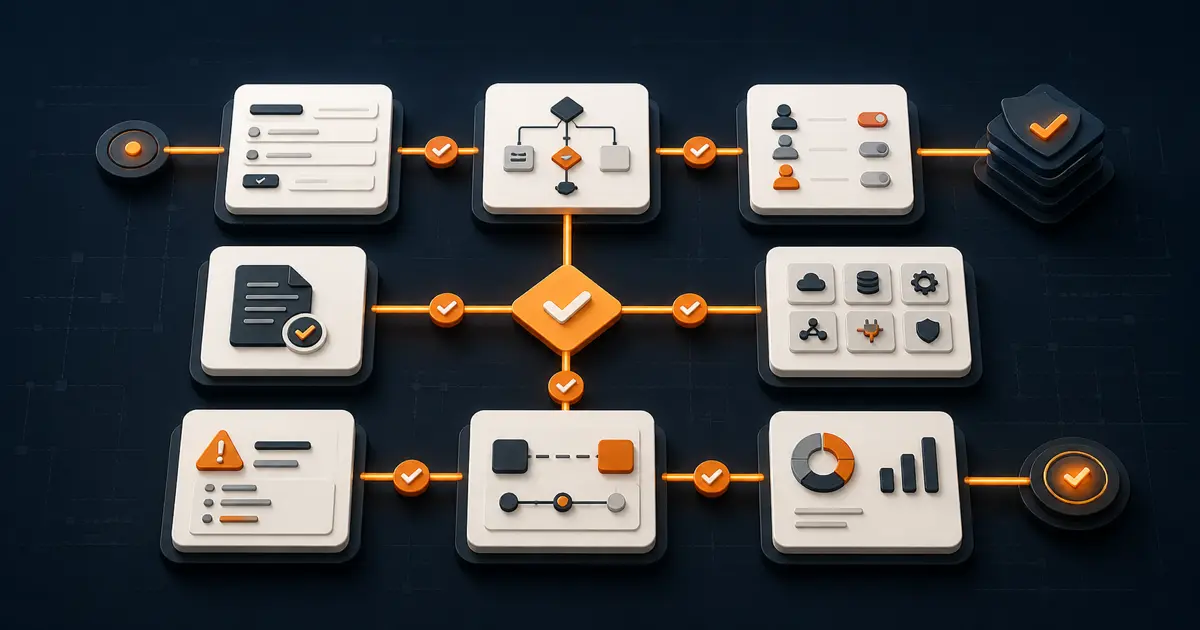
Enterprise approval workflow software should do more than move a request from one inbox to another. It must execute your authority rules, keep sensitive data in the right hands, preserve decision evidence, recover from failures, and show operators what needs attention.
The best evaluation turns every requirement into an acceptance test. Define the trigger, the expected result, and the evidence the system must produce. Then ask each vendor to run the same cases.
Turn every requirement into a testable contract
A feature name is not a requirement. “Supports multi-step approvals” tells you almost nothing about thresholds, rejected branches, unavailable approvers, or conflicting decisions.
Write each requirement as a three-part contract:
- Trigger: the input, event, role, threshold, or failure that starts the behavior.
- Expected result: the route, state change, restriction, notification, or recovery the system must execute.
- Evidence: the record, timestamp, export, notification, or report that proves what happened.
For example: “When a purchase request reaches $50,000, the system must add Finance and a vice president as required approvers, prevent the requester from approving it, and record the rule, reviewers, timestamps, and outcomes.” That statement gives a vendor something concrete to demonstrate.
Gate 1: prove the software fits the approval workflow
Start with the business rules. A strong security presentation cannot rescue software that cannot represent how decisions actually move.
1. Structured intake rejects incomplete or invalid requests
Requirement: The request interface must collect the fields reviewers need, apply valid formats and ranges, require supporting evidence when conditions demand it, and prevent duplicate or incomplete submissions.
Acceptance test: Submit a purchase request without a cost center, enter an amount outside the allowed range, upload the wrong file type, and submit the same external reference twice.
Evidence: Capture the validation message, accepted field values, duplicate-control result, and final stored record. The U.S. Government Accountability Office's 2024 FISCAM treats input validation, duplicate detection, independent review, and retained evidence as important business-system controls.
2. Routing rules handle boundaries without gaps
Requirement: The software must route by fields such as amount, department, risk, location, data access, or contract type. Every value must match one route or a controlled fallback.
Acceptance test: Run requests at $9,999.99, $10,000, $49,999.99, and $50,000. Add a request with a missing department and one that matches a risk override.
Evidence: Record the route selected for each case, the rule that caused it, and the fallback result. Use an approval matrix to define authority first, then apply boundary-safe routing rules.
3. Multi-stage decisions use explicit completion policies
Requirement: The system must support the order your workflow needs and define what completes, rejects, pauses, or cancels each stage.
Acceptance test: Run a sequential request, a parallel request that requires everyone, and a parallel request where one rejection must stop the workflow. Confirm that later stages cannot act too early.
Evidence: Capture stage order, participant decisions, completion logic, and the final state. If your team has not chosen the model, compare sequential, parallel, and hybrid approvals before evaluating vendors.
4. Exception paths work without admin improvisation
Requirement: The workflow must handle requests for changes, rejection, withdrawal, delegation, absence, escalation, duplicate requests, and manual overrides.
Acceptance test: Send one request back for missing evidence, mark one approver unavailable, withdraw a request after the first approval, and apply an emergency override.
Evidence: Verify the current owner, preserved prior decisions, reason fields, notifications, and final status for every case. Reject any design that requires an administrator to edit records quietly to keep work moving.
Gate 2: prove the software preserves control
Once the happy path works, test who can see, change, approve, and verify each part of the record.
5. Roles enforce least privilege and separation of duties
Requirement: Requesters, reviewers, administrators, auditors, and integration accounts must receive only the access they need. The same person must not request and approve a controlled item when policy forbids it.
Acceptance test: Sign in as each role. Try to view a restricted field, change an approval threshold, approve your own request, alter a closed decision, and inspect audit evidence.
Evidence: Keep a role-permission matrix and the result of each allowed and denied action. NIST SP 800-53 Revision 5.1 calls for documented separation of duties and access authorizations that support it.
6. Audit evidence explains every material event
Requirement: The record must show what happened, when, where or in which workflow, who or what caused it, and the outcome. It should preserve the rule version and evidence reviewers saw when they decided.
Acceptance test: Change a request, reassign it, approve it, reopen it if allowed, and trigger an integration. Ask an independent reviewer to reconstruct the history without opening email or chat.
Evidence: Export or inspect the event history and compare it with the approval workflow audit-trail checklist. NIST AU-3 identifies event type, time, location, source, outcome, and associated identities as core audit-record content.
7. Integration failures do not create silent divergence
Requirement: When the workflow sends data to finance, HR, CRM, storage, or messaging systems, it must define retries, duplicate protection, error ownership, and recovery.
Acceptance test: Disable a test endpoint, return a timeout, send the same event twice, and restore the connection. Confirm whether the approval pauses, retries, raises an alert, or completes with a visible exception.
Evidence: Capture attempt IDs, timestamps, payload status, retry results, final destination records, and the operator alert. “Integration available” does not pass this test.
8. Workflow changes follow controlled release rules
Requirement: Teams must know who can change fields, routing, permissions, templates, and integrations. The platform must support a review, test, release, and recovery approach that matches the workflow's risk.
Acceptance test: Change a threshold while requests remain open. Confirm which rule version applies to existing and new requests. Introduce a faulty notification rule and restore the approved configuration.
Evidence: Preserve the change request, approver, test results, release time, affected version, and recovery result. NIST CM-3 treats configuration change control as a defined, documented, reviewed, approved, and tracked activity.
Gate 3: prove the software will remain operable
The platform must still make sense after the launch team moves on, volumes rise, owners change, and auditors ask for old evidence.
9. Data lifecycle rules cover retention, export, and exit
Requirement: Define where request data and attachments live, how long records remain available, who can export them, how deletion works, and what the company receives if it leaves the vendor.
Acceptance test: Export a complete request with attachments and event evidence, retrieve an old closed item, apply a test retention action, and map the exported fields to a replacement system.
Evidence: Keep the export, field dictionary, attachment manifest, retention result, and documented exit steps. GOV.UK's spreadsheet guidance highlights versioning, audit, and archiving because business-critical records often outlive the tool or format that created them.
10. Long-running requests survive ownership and service changes
Requirement: The workflow must preserve active requests across staff departures, delegated roles, expired credentials, configuration releases, and temporary service failures.
Acceptance test: Remove an assigned reviewer, rotate an integration credential, and deploy a rule change while a request waits at stage two.
Evidence: Show the reassigned owner, unchanged evidence, resumed actions, and any alerts. Ask vendors to state duration limits and continuity behavior in writing.
11. Reporting shows risk before stakeholders start chasing
Requirement: Operators need current views of queue age, cycle time, rework, exceptions, SLA risk, throughput, and overdue ownership.
Acceptance test: Seed requests across stages and ages, including a reworked item and an overdue high-risk request. Confirm that totals reconcile to underlying records and filters preserve the same definitions.
Evidence: Keep the report, calculation definitions, filtered record set, and reconciliation result. Use the same measurement contract described in the approval workflow metrics guide.
12. Business builders can improve the workflow without creating shadow IT
Requirement: Operations should be able to maintain approved fields, rules, notifications, and views. IT must retain governance over access, data movement, and risky changes.
Acceptance test: Ask an operations owner who did not build the pilot to add one field, update one approved rule, find one stalled request, and explain the workflow to a backup owner.
Evidence: Record completion time, errors, help required, published change evidence, and the backup owner's explanation. A successful demo should prove maintainability, not just builder speed.
Run one pilot that forces the hard questions
Use a purchase request because it combines structured data, financial authority, cross-functional review, attachments, and downstream actions. Build these cases into the pilot:
- A $9,999 request that needs a manager only.
- A $10,000 boundary request that adds Finance.
- A vendor request that adds security review because the vendor will access customer data.
- An incomplete request that returns to the requester without erasing the first review.
- An approval assigned to someone who becomes unavailable.
- An approved request whose downstream finance integration times out and later recovers.
Run the six cases with requester, manager, Finance, security, administrator, and auditor roles. If a vendor cannot demonstrate a case safely, record it as a gap. Do not replace the failed test with a presentation slide.
Score critical failures separately from preferences
A weighted score can hide a dangerous result. A platform might earn high marks for builder experience, reporting, and design while failing separation of duties or evidence retention.
Classify requirements before the pilot:
- Pass or stop: mandatory security, governance, legal, or operational controls.
- Weighted: capabilities where stronger execution earns more value.
- Roadmap: desirable items that do not affect the immediate decision. Treat uncommitted vendor plans as unavailable.
For every score, link the test case and evidence. This gives procurement a defensible record and gives the implementation team a ready-made regression pack.
Use the same acceptance script when you evaluate Formaloo
Formaloo's current Help Center shows how teams can collect requests with a form, keep internal status and Assignee fields away from public requesters, route form submissions with Advanced logic, trigger actions on submission or update, and organize form submissions in Tables, Kanban boards, charts, or portals.
Those connected building blocks let operations teams test intake, routing, ownership, status visibility, and requester access in one system. Your enterprise review should still apply the same 12 tests and require clear evidence for every mandatory control.
If you want to evaluate a real approval workflow with your own rules and test cases, Book a demo.
Sources
- Formaloo Help Center: How to build an approval workflow in Formaloo
- Formaloo Help Center: How to add advanced logic to your form
- Formaloo Help Center: How to assign form submissions
- Formaloo Help Center: How to organize form submissions with Data Blocks and portals
- NIST SP 800-53 Revision 5.1
- U.S. GAO: Federal Information System Controls Audit Manual, 2024 revision
- GOV.UK: Creating and sharing spreadsheets
Sources and product guidance reviewed on August 15, 2026.


.webp)